
Champions League Yellow Card Rule Change Explained as UEFA Introduces New Suspension Threshold
Paris Saint-Germain begin their title defence after beating Arsenal in last season's final, while Manchester United and Aston Villa return to the competition and a number of Europe's biggest clubs have strengthened their squads.
With so much at stake, avoiding unnecessary suspensions could prove crucial.
The biggest change concerns yellow cards.
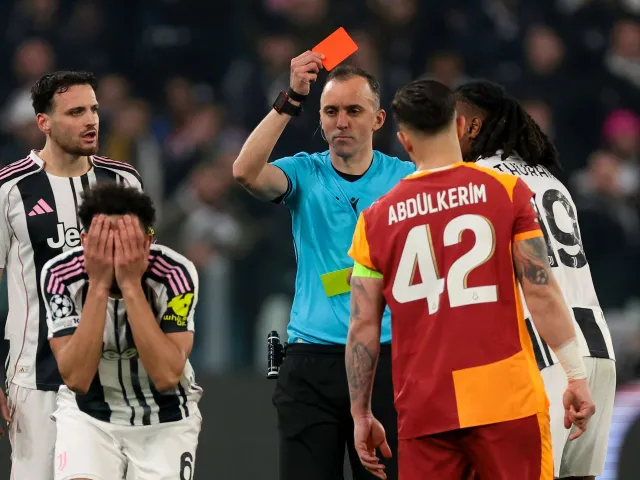
From the league phase onwards in the 2026/27 Champions League, a player or team official will now receive a one-match suspension after four yellow cards, rather than three.
How do Champions League suspensions work?
A player or team official who is sent off is automatically suspended for the next match in a UEFA club competition.
That applies across UEFA's three major men's club competitions, meaning a suspension can carry into the next UEFA competition in which the player is eligible to participate. UEFA's disciplinary bodies can also increase the punishment for serious offences.
For example, a red card in the Champions League can result in a suspension being served in the player's next UEFA club competition match.
The same principle applies to team officials who are sent off.
Champions League yellow card rule changes
The important change for the 2026/27 campaign is the number of yellow cards required for a suspension.
Under UEFA's current Champions League regulations, from the first match of the league phase, a player or team official is suspended after four yellow cards that have not resulted in a red card.
After that, suspensions are triggered by every subsequent even-numbered caution.
That means the thresholds are:
Four yellow cards: one-match suspension
Six yellow cards: one-match suspension
Eight yellow cards: one-match suspension
10 yellow cards: one-match suspension
The rule is different before the league phase, where three yellow cards can trigger a suspension, followed by further bans at the fifth, seventh and other odd-numbered cautions.
What happens to yellow cards in the knockout stages?
There is another important rule for clubs hoping to make a deep Champions League run.
Yellow cards are carried forward through the competition, but all yellow cards expire when the quarter-finals are completed.
They are therefore not carried into the semi-finals.
That creates an important distinction.
A player who reaches the four-yellow threshold during the quarter-finals will still be suspended for a semi-final match because the suspension itself has been triggered.
However, a player who simply carries yellow cards into the end of the quarter-finals will see those cautions wiped before the semi-finals.
Can a player be suspended for the Champions League final?
Yes — but a yellow-card accumulation alone cannot cause a player to miss the final if the cautions have not already resulted in a suspension.
Because yellow cards expire after the quarter-finals, a player cannot accumulate cautions across the semi-final legs and then be suspended for the final solely because of those bookings.
A red card in the semi-finals, however, can result in a final suspension, subject to UEFA's disciplinary process.
Why the rule matters
For Europe's biggest clubs, managing suspensions could become particularly important during a long Champions League campaign.
The new four-yellow threshold gives players more room before their first automatic suspension during the league phase, but repeated bookings will still quickly become a problem.
Once a player reaches six, eight or 10 cautions, another booking at the relevant threshold brings another one-match suspension.
For managers, that means squad depth and disciplinary management could become increasingly important as the competition moves towards the knockout rounds.
Champions League suspension rules at a glance
| Number of yellow cards | Suspension |
|---|---|
| 1–3 | No automatic suspension |
| 4 | One match |
| 5 | No additional suspension |
| 6 | One match |
| 7 | No additional suspension |
| 8 | One match |
| 9 | No additional suspension |
| 10 | One match |
The thresholds apply from the first match of the league phase. Before that stage, different accumulation rules apply.
With PSG attempting to defend their crown and 36 clubs competing in the expanded league phase, avoiding costly suspensions could be one of the less glamorous but decisive parts of the Champions League campaign.
For players, the message is simple: four league-phase yellow cards now means a ban — and the rules change again once the knockout stages arrive.

Senior Sports Correspondent - Oliver Whitmore is a distinguished sports journalist and senior correspondent with extensive experience covering elite sport for prominent media platforms. Known for his authoritative reporting, incisive analysis, and sophisticated storytelling, Oliver has developed a strong reputation for delivering compelling coverage of major sporting events, athletes, teams, and the wider sports industry.
More from this author →Related Stories
 Champions League
Thursday Night Champions League Explained: Why UEFA Has Changed the Schedule Again
 Champions League
PSG Have Already Made History — Now Luis Enrique Wants the Champions League Feat Only Three Clubs Have Managed
 Champions League
Hyundai Make Major Champions League Move as Five-Season Partnership Begins
 Champions League
Comments (0)
Be the first to comment on this story.
Leave a comment